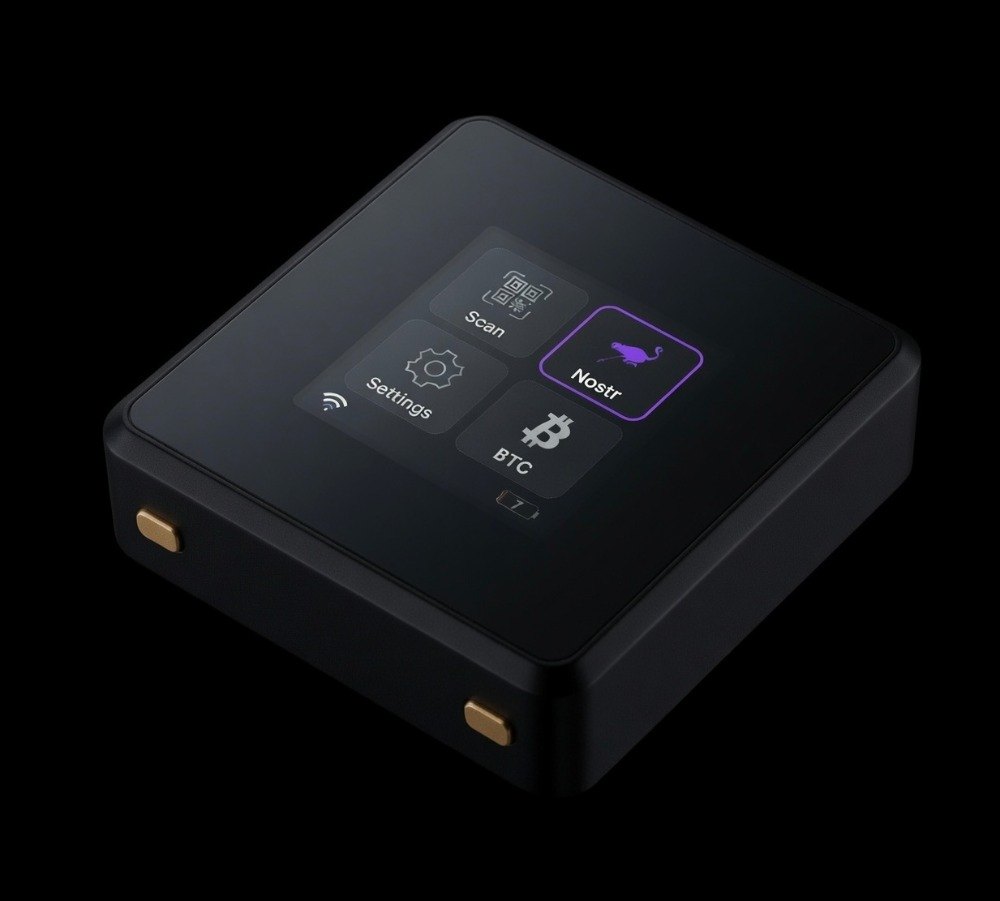
Your key is your name, your followers, your Bitcoin.
It can't be reset. It can't be reissued.
And you wouldn't keep your Bitcoin keys in a browser.
Favilla KEY is the hardware your identity should have lived in from day one.
No jargon required. If you already know Nostr, skip ahead.
01
Your online identity is a key.
On Nostr, you don't log in with an email and a password. Your account is a cryptographic key. You carry it between apps, and no company can revoke it.
Lose the key and the account is gone forever. There's no reset button.
02
Right now, that key is somewhere fragile.
A browser extension. A note on your phone. And the fixes on offer just add more software — new keys delegated from a master key that still sits on an internet-connected computer. The exposure doesn't go away; it grows layers.
Bitcoin solved this years ago: take the key off the computer.
03
Favilla KEY is where it belongs.
We don't rotate around the problem. The master key itself is generated in hardware, sealed in certified silicon, and never exposed — so there's nothing to delegate, rotate, or clean up after.
The same answer hardware wallets gave Bitcoin, finally given to your identity. Nothing else runs on it.
Machined from a solid block of aluminium. Tactile buttons with haptic and audio
feedback — you feel every confirmation. Cover glass over a colour display that
shows you the truth before you sign it. It has weight, because the thing it
protects has weight.
Your keys are generated on the device and live their whole life inside it.
They're never typed into a browser, never synced, never held by us or anyone else.
Sealed in certified silicon. Your keys never sit in plain form anywhere — they're stored as AES-256 ciphertext, wrapped twice. The outer key lives inside an NXP SE051 secure element: Common Criteria EAL 6+ with AVA_VAN.5, the highest assurance tier available in commercial secure elements. Equal to the best silicon in any hardware wallet, and unmatched by any Nostr signer.
Signed off the internet chip. The inner key lives on a second, isolated processor with no radios and no network stack. It takes a hash and returns a signature; it has no command that returns the key. A remote attacker who fully compromised the Wi-Fi chip would find nothing to steal.
Your PIN is checked in hardware, not software. It's verified inside the secure element against a physical retry counter. Wrong guesses are a finite resource — brute force is a dead end, not a matter of time.
Two doors, one rule. Approving a Nostr signature never exposes your Bitcoin. Bitcoin is its own mode, chosen at power-on, with its own PIN entered on the device's buttons — no radio ever comes up in it, there is no network path that accepts the PIN, and the seed opens only against a value the isolated signer mints after a real power cycle. Remote spend isn't disabled; it's impossible by construction.
What you see is what gets signed. Every signature surfaces on the device's own screen — a display no browser, extension, or malware can draw over — before you press accept.
Unless you want it to. Consent is the rule, and it's yours to delegate: keep everything manual, or switch the Nostr events you trust to auto-sign. Policy mode is coming — write your own signing rules, and the device enforces them. The exception: spending from your Bitcoin wallet is always manual, always. Zaps? Auto-sign them if you wish.
Certificates cover chips, not products. So the architecture around ours is built to be read. We document exactly what does what, and where every key lives, so you don't have to take our word for anything.
Power it on and connect — over your home network, or anywhere at all: away from home, the device broadcasts its own network and your phone joins it directly. Your browser pulls a full Nostr client straight from the hardware in your hand. Read, post, zap, DM. No install, no extension, no company hosting anything. If we disappear tomorrow, it keeps working.
Remotely
A remote signer for any Nostr client.
Connect over NIP-46 to any client that supports Nostr Connect. Signing requests travel securely to the device and approvals travel back — even while it sits at home. You post from your phone across town; your key never leaves the house.
And unlike other remote signers, Favilla KEY mints one-time bunker URLs — each consumed by the app that pairs with it, never reusable if leaked. Revoke and mint new ones remotely — only the pairing that controls the others is reserved for the device itself.
Zaps via NWC — point it at your own node or a custodial service. The zap request is signed on the device; the payment goes out from your wallet connection.
Remote sessions you control — see every paired client, revoke any of them, mint new pairings. Even remotely.
Your relay, by default ours — the device publishes once to relay.favillakey.io, which fans out to the public relays. Swap in your own from the settings.
Encrypted apps protect the pipe. We protect the phone too.
End-to-end encryption stops anyone reading your messages in transit. But once they're
decrypted on your phone, they're readable by whoever holds it. The key that unlocks
them lives on the same device they sit on.
Typical messaging apps
Unlocked phone, open book.
Your message history is decrypted with keys stored on the phone itself. Anyone who gets into the phone — thief, border agent, spyware — gets your conversations with it.
Favilla KEY
Lock the device, seal the history.
In the client served from the device, DMs are cached encrypted on your phone or computer, and the key that opens them lives in Favilla KEY's hardware. Messages are readable only while your KEY is unlocked. Lock it, and they seal again.
Every DM that leaves the device is NIP-44 v2 encrypted. Modern conversations ride NIP-17 gift-wrap end to end — sender identity hidden from relays.
Gift-wrapped zaps inside DMs. Value moves as privately as the words around it.
Decryption happens on the hardware, gated by your PIN. Plaintext never touches a server — ours or anyone's.
First production run
Get early access.
Designed and assembled in Perth, Australia. Drop your email and you'll be first
to know when the first units are ready.