Favilla field notes · mining · October 2026
Why bitcoin mining outlasts the AI build-out
The mining chip is nearly finished. The AI chip is nowhere near it. That sounds like bad news for bitcoin, and it is the other way around.
I was at the Bitcoin Bush Bash in Busselton on the weekend and met a lot of great people. One conversation stuck with me. I got talking to a director at GreenBit, who build a mini miner here in Australia, the Bitaxe idea without the noise, and the thread kept pulling in the same direction. Where does the energy go, what does mining look like once the hardware stops improving, and what happens to all the capital currently pouring into AI when the music slows down. I did not have good answers on the day. This is me working them out properly.
The mining chip is nearly finished
A bitcoin mining chip does one thing. It computes a single hash function, over and over, and nothing else. There is no software on it, no memory to manage, no data to shuffle around. Once the designers have laid that one function out on silicon as tightly as it will go, the only way to make it better is a smaller manufacturing process, and that lever is running out for the whole chip industry.
You can see it in the numbers. Each new generation of mining chip is a smaller improvement than the last, and the recent ones all come off the same class of process. One more step is possible at enormous cost. After that, the gains come from cooling and tuning, not from the chip. Mining hardware is within a generation or two of a practical ceiling.
The AI chip is nowhere near it
AI chips are the opposite. The problem they solve keeps changing, so there are several independent ways to make them faster that have barely been touched. Lower precision maths, better memory, better packaging, entirely new architectures, and on top of all of that the algorithms themselves keep improving. AI compute per watt will likely keep doubling every couple of years for a long time.
That sounds like good news for AI and bad news for bitcoin. It is the other way around, and the reason is money.
Why a ceiling is good news
If your chips keep doubling in performance, the chips you bought last year are worth half as much. A GPU bought today has to earn back its entire cost in four or five years before it becomes scrap, in a market where the price of what it produces falls by ten times every year or two. That is the deal every dollar going into AI hardware is signing up for. Some of it will pay back handsomely. A lot of it will not, and nothing the owners do can change the fact that the asset is melting on a fixed clock.
When mining chips hit the ceiling, that stops happening. The machine you buy stops going obsolete. It becomes a generator or a transformer, something you run for a decade. Mining shifts from a hardware race, where capital is destroyed every cycle, into a plain energy business, where the only things that matter are your power price and your patience. That is a much healthier place for an industry to be, and nobody else in the compute world gets to go there.
Mining shifts from a hardware race, where capital is destroyed every cycle, into a plain energy business, where the only things that matter are your power price and your patience.
Where the capital goes
AI today is new, the way bitcoin was new. It is priced on future value, and every dollar and every kilowatt going in is not yet producing a dollar or a kilowatt of value out. That is not a criticism. It is what every build-out looks like from the inside. Railways looked like that. The fibre glut of 2000 looked like that. The bets were right, the timing was wrong, the first investors lost their money, and the infrastructure was picked up cheap by whoever used it next.
We have already watched the flow run one way. Miners turned their sheds and power contracts into AI hosting because the lease paid better. Those sites do not care what runs in them. When part of the AI capacity ends up stranded, and some of it will, the owners will run whatever pays the power bill. Hashing is the one workload that always has a buyer, with no customer to find and no contract to sign. The GPUs will not come back to mining. The power and the buildings will.
Then there is the money itself. Capital that has just been burned on depreciating hardware in a crowded market goes looking for the opposite. Something scarce, that does not wear out, that nobody can make more of. In the first panic it goes to cash, it always does. On a longer view, a portion of it finds its way into the one asset with a fifteen year record of absorbing exactly that kind of rotation. Against a supply that cannot respond, even a modest, repeated reallocation from a market measured in trillions moves the price a long way over a decade. Every cycle so far has had the same shape, and I see no reason this one ends differently.
And it loops back. A higher price means more revenue per hash, which pulls more stranded energy into the network, which makes the network harder to attack, which makes the asset safer to hold, which draws more capital. The AI build-out is, without meaning to, building the power and the sites that mining will inherit, and teaching the lesson that will send capital toward the asset mining secures.
The miner on my desk
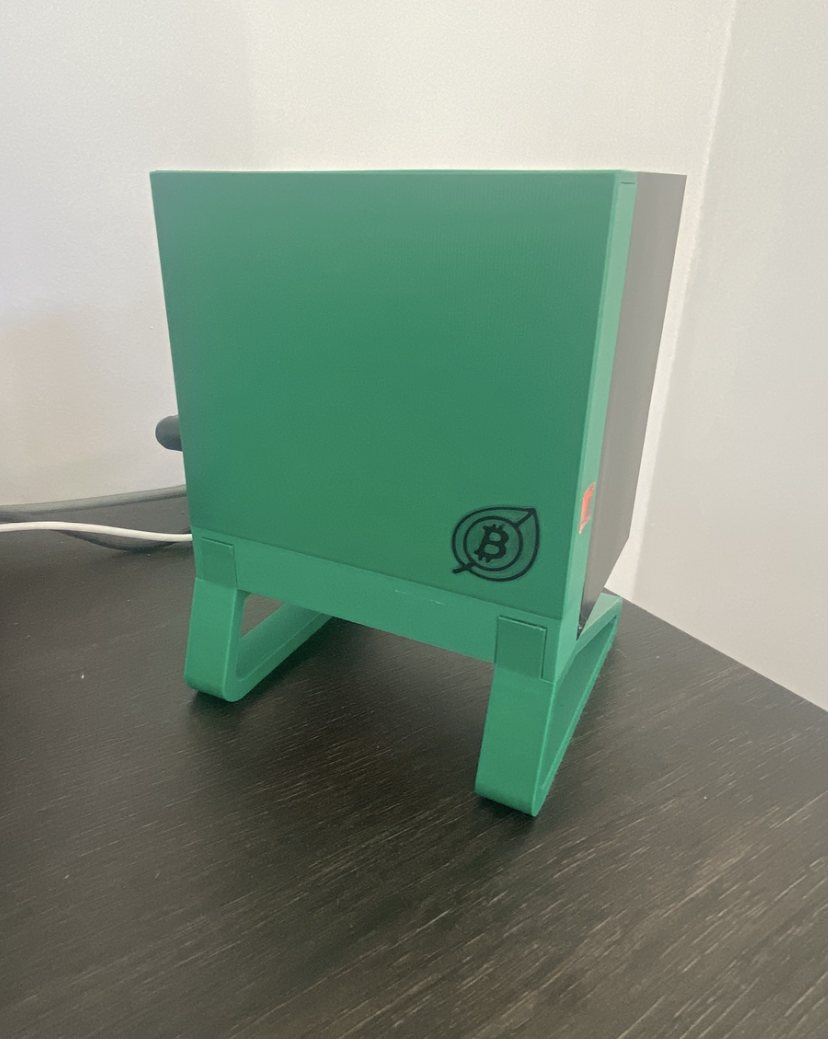
I bought one of their satboy miners before I left. Not because the maths works. A single chip home miner is a lottery ticket and I know it. I bought it because it is the smallest honest version of everything above. It turns 20 watts into heat on my desk, no fan, no noise, and in exchange it gives me a block template I chose, firmware I can read, and a tiny stake in the network staying the way it is.
Mining is about to get boring, industrial and permanent. The hardware will stop changing. The question of who controls it, and whether you can trust it, never will. So the little miner stays on the desk, quietly doing its bit, and when the capital comes back around it will already be there.